
From Field to Fresh: How Corrigan Protects Perishables Every Step of the Way
Fresh produce starts losing water the moment it’s harvested. From that point forward, every hour, every handoff, and every environment it passes through either helps preserve its quality or chips away at it. At Corrigan, we’ve spent more than 45 years engineering humidity, misting, and water treatment solutions that protect perishables at each stage of that journey, from post-harvest storage all the way to the retail shelf.
Here’s a look at how our technology follows produce, and the people and retailers it reaches, from farm to store.
Why Humidity Is the Hidden Variable in Freshness
Temperature gets most of the attention in cold chain conversations, but researchers who study postharvest handling point to relative humidity as an equally critical factor. Fresh fruits and vegetables are living tissue that’s roughly 80 to 96 percent water, and they continue to respire and lose moisture long after harvest. That ongoing water loss through transpiration is one of the primary drivers of quality decline. It’s what causes wilting, shriveling, softening, and loss of salable weight.
The science backs up just how much humidity matters. A comprehensive review of postharvest research found that storing produce at high relative humidity helps preserve cell structure, slows senescence, and maintains nutritional quality. Extension research from institutions like NC State and the University of Maine notes that most fresh produce needs relative humidity in the 80–95% range to slow respiration and metabolic breakdown, with leafy greens often requiring 95–100% RH. Get the humidity level wrong, even by a small margin, and the effects compound quickly: one postharvest study found that at low temperatures, humidity variations of less than 1°F in dew point can meaningfully change how fast produce loses water.
The stakes are significant. According to the University of Maine Cooperative Extension, improper temperature or humidity management can drive postharvest losses of 10 to 40 percent in horticultural crops. USDA’s Economic Research Service estimates that food loss and waste at the retail and consumer level alone totals roughly 31 percent of the available food supply. This is precisely the gap our systems are engineered to close, giving retailers and logistics partners the tools to hold produce in that narrow, correct humidity band at every stage, rather than losing the battle to transpiration before the product ever reaches a customer’s cart.
Stage One: Protecting Freshness Right After Harvest
The race against moisture loss begins immediately after picking. Produce that isn’t kept at the right humidity level starts to shrivel, lose weight, and degrade in quality before it ever reaches a warehouse door.
That’s where precise post-harvest humidity control comes in. In storage facilities and distribution centers of any size, maintaining the right humidity level can cut shrink by as much as half. Our VaporDry™ series systems were built for exactly this challenge: they fill a room with humidity without wetting walls, floors, or product, don’t require costly reverse osmosis filtration, and run reliably with very low maintenance and simple timer or humidistat controls. The series can be specified to fit the facility, from standard VaporDry™ for typical storage and distribution environments to VaporDryHP™ for higher-ceiling or more demanding applications.
Beyond general storage, we also support the specialized rooms that get produce ready for market: degreening rooms, ripening rooms, and cold rooms, each with its own humidity requirements to bring products to the right color, texture, and readiness without compromising freshness.
Stage Two: Keeping Humidity Steady in Transit
Once produce leaves the warehouse, the environment becomes far harder to control. Trucks, trailers, and mobile cold storage all introduce new variables. Corrigan’s VaporDry™ Mobile, part of the VaporDry series, extends precise humidity control into transportation and logistics settings, protecting perishables during the leg of the journey where they’re often most vulnerable.
The technology behind this precision comes down to droplet size. Using precision-machined nozzles and tightly controlled air and water pressure, our VaporDry series systems produce dry fog particles as small as 2 microns and consistently below the 10-micron threshold needed for the fog to evaporate before it ever condenses on a surface. We’ve validated this using laser diffraction particle analysis, so the humidity a shipment receives is measured, repeatable science, not guesswork. That’s what allows VaporDry Mobile to protect produce, and even sensitive machinery or electronics, in transit without adding moisture damage risk.
Stage Three: Knowing What’s Happening, Wherever It’s Happening
Precise humidity control only matters if it’s actually being maintained, and historically, that’s meant someone physically checking a gauge or waiting for a problem to show up as spoiled inventory. Corrigan closes that gap with remote monitoring powered by Tosibox®, now available across our humidity systems.
The system gives operators real-time visibility into temperature and relative humidity 24/7, with automatic alerts the moment conditions drift out of range, whether that’s a warehouse, in transit, or a critical inventory zone during off-hours. It runs on Wi-Fi with no cell charges, connects in minutes with plug-and-go setup, and handles firewall configuration, updates, and authentication automatically. Security isn’t an afterthought either: it uses always-on, point-to-point VPN connectivity with multifactor authentication and data encryption.
For a facility manager, that translates into faster response times, stronger regulatory compliance, and most importantly for perishables – less downtime and less waste. Instead of discovering a humidity failure after the product has already degraded, remote monitoring catches the drift while there’s still time to act.
Stage Four: Making the Case for Freshness at Retail
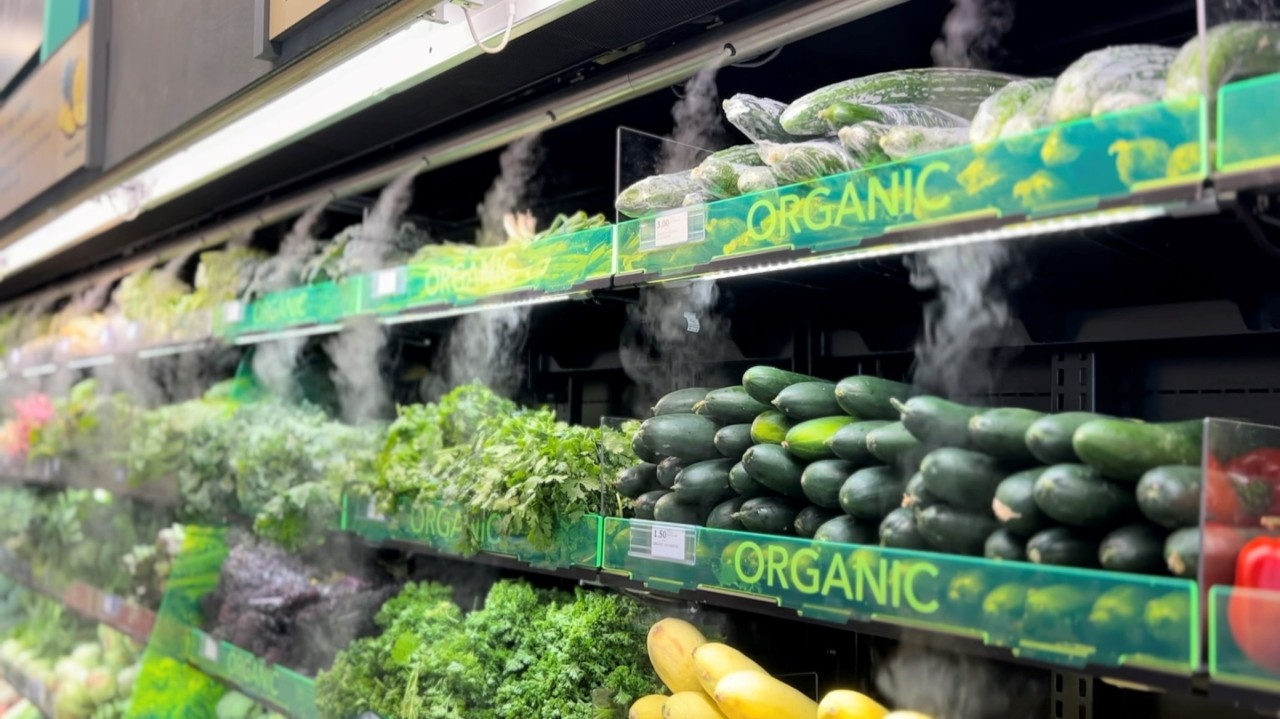
By the time produce reaches the store, it’s already lost moisture. And the produce case is a shopper’s first, most influential impression of that store. This is where our misting and humidification technology does some of its most visible work.
Our UltraMist™ system creates a thin, dew-like moisture barrier over produce displays, which helps:
- Extend shelf life and reduce shrink
- Preserve chlorophyll and vitamin content
- Keep produce looking vibrant for shoppers who buy with their eyes
- Support larger, more varied displays
For retailers who want the visual and preservation benefits of misting without any wetness, our patented Préserve™ system takes it further. Préserve produces a non-wetting, dry fog as fine as 5 microns that raises humidity around produce to slow transpiration and extend shelf life, all while staying dry to the touch. It’s built on a closed-loop plumbing system with point-of-use nebulization, eliminating the open-water reservoirs found in ultrasonic systems, and it’s NSF/ANSI 169 certified for food equipment safety and sanitation. We also paired it with TriOBreeze™, our activated oxygen disinfection technology, which automatically sanitizes the mist bar, nozzles, and drain lines, with no chemical residue and no added maintenance burden.
Together, these systems don’t just make produce look better. They protect the case, the water usage, and the store’s bottom line.
Why the Full Journey Matters
It would be easy to think of freshness as a single moment: when a customer picks it up. But freshness is really the result of everything that happened before that moment: how it was stored after harvest, how it was handled in transit, and how it was cared for once it hit the shelf.
When every link in that chain is treated with the same level of care, the results compound. Produce arrives at the store in better condition, holds up longer under retail lighting and handling, and stays fresher once it’s in a customer’s kitchen. That’s fewer markdowns and less shrink for retailers, and less food waste industry-wide.
At Corrigan, this full-chain approach isn’t new to us. It’s the same principle our founder built the company on nearly five decades ago, when he first recognized that fresh produce needed better environmental controls to survive the trip from farm to store. We’ve just kept engineering better ways to deliver on it.
Want to learn more about how Corrigan’s post-harvest, transportation, or in-store solutions could fit your operation? Reach out to our team for a free quote.